Torchwood writer and Twitterpal James Moran turned me on to this righteous trailer that brings back that coffee-black blaxsploitation groove you know we were all hurtin’ for ever since The Man took it all away from us. Set in the early 70’s, if this thing is half as good as the trailer makes it look, we may be in serious need of some new Dolemite action in the not-too-distant future!


Even After All These Films ...
Aug 19, 2009
I have seen, in my life so far, at least 1500 movies.
That’s not an idle boast: I have supporting documentation from the film festivals I’ve covered, the reviews I’ve written and other sources to confirm at least that number. On the AFI’s list of the 100 Greatest (American) Films (2007 Edition), I’ve seen 73 of them. I would guess that there are a handful of movies I’ve seen more than 50 times, dozens I’ve seen more than 20 times, and hundreds I’ve watched more than once
In short, I am a serious movie geek. And yet after all these years, and all those films, someone like me can still get excited and “hyped up” over a forthcoming movie.
Of course, I’m a trickier customer to please than your average schmoe who actually goes out to the cinema maybe six-to-eight times a year. I know these plotlines. I recognise storytelling techniques. I notice shortcuts, edit points, lighting, cinematography, the whole mix. And I can tell when a trailer is giving me a distorted view of what the film’s really about, or when it’s trying to salvage a turkey, or just trying to get by on quick cuts, explosions and a touch of T-n-A.
But certain trailers still get me excited, usually if they have a very distinct look to them, or communicate clearly that this is the sort of film that will only really work well if you watch it in a cinema, or make it obvious that everyone involved is very proud of how it turned out. A good example of these sorts of trailers would be the ones for Amalie, City of Lost Children, The Chronicles of Narnia, The Lord of the Rings, and Pan’s Labyrinth.
This trick doesn’t always work: the trailers for the recent remake of Charlie and the Chocolate Factory, Speed Racer and Star Trek actually served to lessen, not raise, my interest in these films. It takes more than just fantastic visuals to get me worked up, there has to be a promise of a story, of the creative vision and imagination necessary to really take me somewhere.
As I sat in the cinema recently for the most recent Harry Potter movie, I noted with some alarm that out of six trailers for upcoming films, five of them were based on TV shows, comic books or toys of the 70s and 80s. Only one was for an original story. How depressing.
Happily, I just stumbled across an HD version of the one trailer I’ve seen in the last year that has me chomping at the bit to see it: the one for The Imaginarium of Doctor Parnassus.
I’ve been a fan of Terry Gilliam since about 1971 or so, when I got my first glimpse of him in “Monty Python’s Flying Circus,” and have since discovered and enjoyed nearly everything he’s ever done before or since that point. He’s definitely one of my favourite directors, despite his ability to sometimes miss the mark. He’s had a dud or two, and indeed the last one starred Heath Ledger, as does Imaginarium.
I hope audiences will have long forgotten the similarly-named but pretty-bad Mr. Magorium’s Wonder Emporium and that it being Heath Ledger’s final film will push mainstream filmgoers to give this a chance, even though the trailer just screams “This is weird! It will disturb you! It will challenge your comfortable notions!!” I would so love this to be widely seen, and having almost every popular male screen idol in the thing (Jude Law, Johnny Depp and Colin Farrell stepped in to finish the film in Ledger’s stead after his accidental death) might ironically not only salvage the film but make it a mainstream hit.
Have a look and see for yourself. I personally can’t wait.
The Longest Way
Aug 18, 2009

What follows is, rather unusually for this site, not a film review of a movie shown in cinemas, but a video on the inter-tubes. I don’t plan to make a habit of this, but this one is extraordinary enough on various levels to warrant the same kind of attention given to traditional movies.
You can find out more about the young man who made the video via his website (currently overloaded) if his story interests you, so I will only recap it very briefly here: Chris Rehage walked almost the entire width of China, from Beijing to Ürümqi over the course of a year. Rather than just “take pictures and/or video” as most of us would have done, he was inspired by the “picture per day” videos that have become a fashion on the net, but took it a definite notch up from there.
This is a brilliant fusion of photo-journal diary, time-lapse travelogue and music video, beautifully edited to a fabulously incongruous soundtrack. I think it really “raises the bar” on self-made travel videos and rises to the level of a genuine work of filmic art.
The first time you watch it, you will likely (and should) focus on Rehage’s own metamorphosis over a year’s time; as he says, “one year walk/beard growth time lapse.” But there’s a lot more going on there; you’re watching a man step into the unknown, and it doesn’t always go to plan. It’s part of the fascination of these sorts of self-portrait videos, looking directly into their eyes.
The second time you watch it, try to look past Rehage most of the time and notice his various surroundings; where he lingers, what goes by fleetingly, all the detail captured in the background. You may be surprised what (mostly) rural China has in store for you ...
I also suggest a third, more frame-by-frame (or at least slowed-motion) view so you can catch captions and combined details of each photo (and often, photo-sequence) composition.
One of the best things about projects like this is that modern photography is very “high-def” and so while we are constrained by annoyances like “economical file size” and “bandwidth” in determining how “big” a picture we can see, the “original” in Rehage’s possession is entirely suitable for future, larger presentations. I look forward to seeing a real “HD” version of this again soon.
The Longest Way 1.0 - one year walk/beard grow time lapse from Christoph Rehage on Vimeo.
Harry Potter and the Half-Blood Prince (2009)
Jul 22, 2009
Running Time: 153 min.
Director: David Yates
Stars: Daniel Radcliffe, Emma Watson, Rupert Grint, Jim Broadbent, Michael Gambon
It’s the beginning of the end for the Harry Potter franchise, and you can definitely feel it.
 Before we get too far into this, I should caution readers that, unlike apparently 90% of the moviegoing audience, I don’t read the books. I know, I know -- “blasphemer!” -- but actually I think I’m much ahead of the game in this regard.
The reason for this is exactly the single biggest complaint I’ve had to listen to, over and over and over, whined incessantly about each of the films since at least the third one: “they left so much out!”
Well yes. It’s a film, not a book. Ask any Lord of the Rings fan about what was left out of the Peter Jackson trilogy, and plan to be occupied with the resulting details for at least as long as the running time of one of those movies.
In particular, Rowling’s penchant for including layers upon layers of detail and plot machinations (along with more than a few red herrings and going-nowhere sub-tales) gives the book exactly the sort of rich texture that readers love and moviemakers cannot possibly accommodate in anything short of a five-hour movie, which would be commercial suicide. Consequently, things get left out. As the hipsters say, “well duh.”
Compounding the problem is the fact that the audience want their magical cake, and to eat it too: they want loads of details (particularly the most important ones), which would normally force filmmakers to stretch out the franchise as they have opted to do with the finale; but they also want the kids to look at least something like the ages of the characters they are portraying. HP fans are seemingly unaware of how much effort and how long a special-effects-heavy epic like each of the HP films take to produce -- the child actors are already considerably ahead of their characters’ ages. Harry was 11 years old in the first film, which means he should be 16 in The Half-Blood Prince. Daniel Radcliffe is as I write this about to turn 20 (he and I share a birthday, as it happens!), and the other leads are similarly aging well beyond their alter-egos. Had Warner Brothers opted to make two films each for each book beyond the third, it would have required re-casting the lead roles by the fifth book’s adaption.
So all the moaning about how much of this book is missing is falling on deaf ears with me, in part because (not having read it) I don’t know what I’m missing, and in part because I understand (apparently much better than HP fans) how films are made, and usually (but not always) trust the production team to have a good sense of what parts are the most “filmic” and what wasn’t, given their limitations. This can involve re-arranging events, jettisoning some storylines or even inventing new action to “bridge” between the remaining elements most efficiently. Peter Jackson in particular did a damn fine job of this balancing act in his LotR films, I thought (and yes, I had read the books beforehand for that one!), but Harry Potter and the Half Blood Prince is hardly the first book adaptation to change dramatically (pardon the pun) from page to screen. Purists need to get over themselves a bit, methinks.
Not reading the books frees me considerably to enjoy (or not) each film as a film, and to be surprised or shocked or whatever Rowling (plus the film creators) intended. I’m also pleased to know that when (or if) I choose to read the books, a wealth of additional layering, detail and general imagination await me. Given the obvious emotional attachment the books engender in their readers (and the consequent strong mixed feelings this film more than the others is engendering in its audience), even if I’d read the books back when they came out I’d have made a strong effort to forget the finer points and just enjoy the ride of this film as a related but not necessarily faithful endeavour.
 So, finally, to the point: given my particular perspective, did I think it was good? The answer is yes, quite emphatically. Indeed, I have to say I enjoyed this one more than at least the last three outings (which, as films, were mostly convoluted messes, particularly Order of the Phoenix). On most occasions beyond the first film, the makers chose to try and cram as much of the books as possible into an impossibly tight timeframe, resulting in half-developed plotlines, rapid-fire editing, intros and outros of myriad characters without any reason to pay attention or care about them, jibberish passing for plot exposition (usually relayed breathlessly) and good old confusion abounding.
That's not to say there wasn’t plenty to like in the recent films; I enjoyed most of Goblet of Fire, only being annoyed by the introduction of a new, bland character who’s only (and obvious) job was to get killed off at the end (Cedric Diggory) and the poorly-edited and badly-rushed Quiddich World Cup sequence that starts off the movie, which prompts questions from non-readers like me such as “if they’ve had Floo Powder all along, why on earth are they using a train to get to Hogwart’s?” to which readers roll their eyes, sigh in an exasperated manner and attempt to relate all the additional detail in the book that smoothes over this obvious plot hole.
Likewise, Prisoner of Azkaban and Order of the Phoenix in particular are (in my opinion) almost unwatchable god-awful mish-mashes of incoherent plotting and superficial vehicles seemingly made primarily to trot out yet more dead-end characters and give employment to nearly every A-list British actor on Earth, despite usually good performances from the array of regular and guest stars and (at least since the fourth film) decent direction. In both movies, there is so much hinting at so much more going on, every line dripping with forced attempts to make it say all the dialogue that wasn’t there. The tantalizingly strong auxiliary characters (like Gilderoy Lockhart, Cornelius Fudge and “Mad-Eye” Moody among many others) and the bewildering locations and elements are often wasted in a hodge-podge of editing that tries desperately to keep the film together but fails for the most part, even loaded as each film is with beautiful sequences, good-looking casting and Rowling’s own (and very charming) sense of the ritual of growing up.
For The Half-Blood Prince, someone somewhere (presumably director David Yates) finally put their foot down and did the right thing: cut the book unmercifully in the name of making an actual, workable, coherent, enjoyable adventure film. From my perspective, they succeeded at last, and one can only hope that they will use the extra “breathing room” the stretched-out finale will give them to do more of the same: treat the novels as a guideline, not the script itself, and craft a meaningful film instead of a picture-postcard of the most visual moments from the story.
That’s not to say it was flawless: quite a number of characters seen in previous films get pretty short shrift in this one, some to the point where I have to wonder why they were included at all. Hagrid (Robbie Coltrane) in particular serves no real function in the story, except to lose yet another pet (which, again from my perspective, is about all this guy ever does!) and provide a locale for Slughorn’s big moment (which really could have happened anywhere, and indeed the convoluted way Potter gets Slughorn to Hagrid’s hut is one of the only really off-key notes in the movie). Other characters so important in the plots of previous films are given barely-even-cameos in this one (for example, Neville Longbottom or Argus Filch and so on), reminding us that they’re still there, but leaving us wondering why nothing significant seems to happen to them anymore. Even most of the professors are reduced to a single line or two, even ones (like Maggie Smith’s Professor McGonnagal) who seem to be important to the plot of the book, but just seem like drop-ins in the film.
There’s not much point in recapping the plot here as most film reviews usually do; everyone reading this likely has a deeper understanding of the story than I do. But this time, I was easily able to follow the sequence of events without feeling like a girl outside the Boy’s Private Clubhouse, and very much enjoyed the more relaxed pace of the film. This allowed me to take note of the evolving acting of the three leads, the truth (very well) infused into the scenes of the kids coming to grips with getting older and raging hormones, and the general affection the characters have for each other as well as that the actors have for their alter-egos. I remember well my own growing-up years (where I looked and acted not all that unlike Ron Weasley) with much affection and it’s obvious JK does as well; her handling particularly of the complexities of teen girls is very on-the-mark, but she gets the male chemistry just right as well. It was smart to explore this more fully than the way similar feelings and depth got butchered in Goblet of Fire.
 Jim Broadbent, without question one of Britain’s greatest actors ever, steals every scene he’s in as retired Professor Slughorn, called back into service by Dumbledore (who gets some much-needed fleshing-out in this one) as part of an elaborate scheme to undermine Lord Voldemort’s plans and prepare Harry for what is to come. Broadbent has to play his character in two time periods separated by 40-50 years time, and pulls it off not just convincingly but marvellously. Ironically, Broadbent’s performance is so high-calibre that it has the unintentional effect of making Alan Rickman’s Snape look utterly ridiculous in all but his most menacing moments. One line particularly well drolled-over by Snape got cascades of laughter from the audience, the opposite of what was seemingly intended.
Tom Felton as Draco Malfoy finally comes into his own in this film, which is as much about him as it is about Dumbledore. His climatic scene shows at last all the ability and complexity that Felton has had to keep well under wraps as the previously-cartoonish Malfoy. Likewise Evanna Lynch’s Luna Lovegood (happily returned from the previous film) gets to be a bit more than just a refugee from Twin Peaks as well. We also have time to see how Fred and George Weasley are getting on with their joke shop, something I would have thought would be cut for more “important” scenes, but give the film a nod of homage to Charlie and the Chocolate Factory and generally add some much-needed levity to the increasingly-darker series. Kudos of the opposite kind must also go to Hero Fiennes-Tiffin, who plays his uncle Ralph Fiennes’ character Voldemort/Tom Riddle as a young boy straight out of The Shining. The resemblance works well and the kid is appropriately creepy.
 Sadly, some characters go the opposite route, getting more cartoonish. Rickman’s Snape has already been mentioned, but Helena Bonham Carter is completely wasted in this film as a cackling, half-mad imbecile, and even all the members of the Order of the Phoenix descend into poor caricatures of themselves. Add to this the number of seemingly-gratuitous cameos of Hogwarts regulars and the shallow interpretations of red herrings like the Dean Thomas character (not to mention the forced-feeling injection of more minorities, albeit still in utterly inconsequential parts), and you get a small army of add-ons that actually detract from the good work done by the main cast. Whether this is a crime to lay at the feet of the writer, the director or the editor I can’t say, but even as someone who doesn’t know the deeper meaning/destiny/importance of these characters, I can see that they cry out to either be expanded upon or discarded.
Harry Potter and the Half-Blood Prince is, I’m pleased to say, worth your money. It’s the first film in quite a while for this series to mostly work well on all levels, and I shouldn’t forget to mention the very strong cinematography, art direction and music which added greatly to my enjoyment. If possible, try to forget the book and give this movie a try on its own merits. You may not love it as much as the muggle devotees, but at least you'll understand why it has such broad appeal -- indeed, this “chapter” of the saga is best compared to The Empire Strikes Back in terms of where (and how) the story has developed (a connection I’m not sure most Potter fans are old enough to make!).
Inflation-Adjusted Box Office Totals
Jul 8, 2009
Now this is a clever idea, and really the way it should be done. BoxOfficeMojo.com has crunched the numbers and given us the real skinny: Gone With the Wind is still the all-time-so-far* box office champion.
 *I really hate the use of the term “all time” without qualifiers, as though Time is officially coming to an end this Thursday and we can finally settle the score. Even worse, most of the time the use of the term “all time” is weighted incorrectly, as box office returns have been up until the publication of this list. You really can’t properly use the term “all time” on anything unless your name is Yahweh. It would really be much better if people put out definitive lists on those things that can actually be considered closed matters, like “best-selling books of the 1800s” and “most popular sandwiches of the 1990s.” These are things we can know. We can never know the best song, or top movie, or worst politician “of all time” because, as Sarah Palin showed us, just when you think you knew who the worst of all time was, another one comes along ...
Anyway, the list holds several nice surprises, as well as vastly increases the diversity and timeline of the films that have ascended to the top. Not all of the top films are great classics, but many of them certainly struck a chord with their audiences and the ones at the top are, without exception, the kind of movies that people watch more than once, often routinely.
One of the biggest surprises in the list is that (when you adjust for inflation) the very top film, the aforementioned GWTW, “only” did $1.5B (all figures US$). This suggests that it might be possible for a film to top this someday (as the totals allow for re-releases), as the worldwide market continues to grow. You have to expect the Lord of the Rings films to move up the charts a bit when the inevitable re-release happens, and I wouldn’t be surprised if the Harry Potter movies are re-released one more time just before the final film unspools.
I was disappointed to see that E.T. did as well as it did. It’s almost certainly just me, but I have never liked the film, thought it very schmaltzy and better-suited to TV at the time, and the re-release and re-edit/re-visionism was just ... an abomination. Even worse than the “Han Shot First” revisionism of the Star Wars re-releases.
The fact that the totals allow for re-releases is the main reason why Disney movies are so well-represented here. Snow White has made many times more money in re-release than it ever did originally. The highest-grossing movie of which I cannot find reference to any sort of theatrical re-release was 1956’s The Ten Commandments, which scored the #5 slot.
I was quite shocked to see that The Rocky Horror Picture Show limped in at a mere #70, a rating that can only mean that midnight screenings don’t count with the compilers of this list as a “theatrical re-release,” because I assure you that film has made way more than (just under) $400M. Heck, I am myself alone probably responsible for 1% of that (I’ve seen that movie many times, though I’m now fairly retired from watching it).
I would be interested to see an adjusted-for-inflation version of the worldwide gross boxoffice chart, rather than just domestic US, but this is a good start that will hopefully inspire a few people to check out some “old” movies.
Speaking of old movies, I note with interest that the all-time-so-far top-grossing B&W movie is the 1945 Bing Crosby film The Bells of St. Mary’s (#49). Other B&W films that made the list are The Best Years of Our Lives (1946, #72) and Sergeant York (1941, #95). I was kinda hoping that 1974’s Young Frankenstein would have made the list, but no such luck.
O.M.F.G.
Jul 3, 2009
Hollywood plans to make a movie of the videogame “Asteroids.”
I think that’s it, we can officially now say that they have hit bottom.
EDIT: I knew when I wrote that I’d be eating my words, but I didn’t think it would only take a day. A movie based on ViewMaster. Oy vey.
I think that’s it, we can officially now say that they have hit bottom.
EDIT: I knew when I wrote that I’d be eating my words, but I didn’t think it would only take a day. A movie based on ViewMaster. Oy vey.

How Now, June COW?
Jun 27, 2009
 The June episode of Crusty Old Wave is up and available from either COW Central or directly from iTunes (where you can subscribe for free if you haven't already, and thus get every new episode automatically!).
We’re doing something a little different this summer ... sequential episodes! Normally we pick which show tape we’re going to edit/remaster/upload at random, but June’s is episode #73, July will be #74 and August will be #75 in honour of the show’s 18th anniversary (!!!).
Naturally this episode has the same bounty of great 80s music you’ve come to expect, but this one also has a special treat -- a complete Nick Danger adventure from The Firesign Theater! Let iPods everywhere rejoice!
The May Cow is was here!
Jun 10, 2009
Just a note for non-Facebook fans ... the May episode of Chas’ Crusty Old Wave came out on June 2nd, and is available for free streaming or downloading from either the COW website or iTunes itself.This is one of the later episodes and I think the variety of music on it is just great. Man I love that guy!
Star Trek Followup
Jun 5, 2009
Where no marketing has gone before:
 No, your eyes do not deceive you -- the chevron logo and the Kirk and Spock figures (among others in the package) are printed directly on the food.
Part of a complete (-ly nerdtastic) breakfast.
Punk Rock (and Chat) in Yer PJs!
May 19, 2009
 While we wait for the May episode of Chas’ Crusty Old Wave, a special treat ... last month Chas and his buddy Liz were live on WPRK once again, sitting in with DJ Maggie on her Punk Rock in Your PJs show.
We chatted about radio days, about Florida and mostly about Canada, and we also listened to some fun, poppy powerpunk (plus a few surreptitious selections from Chas). Great fun, but rather different than what COW listeners are used to ...
If you’re in the mood for something a little bit different, head to Crusty Old Wave Central or iTunes and get your free copy.
Star Trek XI (2009)
May 11, 2009
 Running Time: 127 min.
Director: J.J. Abrams
Stars: Christopher Pine, Zachary Quinto, et al
So I did in fact go to see the new Star Trek film on opening weekend after all, thanks to an invite from some friends (I had planned on catching a matinee after the hype died down a bit). As a long-time “Star Trek” (the original and animated series only) fan and a former professional movie critic, I tried to come to the film with several different mindsets going on at the same time.
First, as a TOS “Star Trek” fan, I expected not to like this. Sure, the casting looked good, but even the trailers had a few “continuity” errors (Kirk drives a stick all of a sudden?) which added to the trepidation.
I also approached this as someone who didn’t really identify with the Braga/Berman era at all, and was glad it was over. To be sure, I’ve watched a number of episodes of each of the various spin-offs from “TNG” to “Enterprise,” and couldn’t warm up to them. I more-or-less gave up on the film franchise after the seventh one (Generations) and saw the remaining three films on cable (and thought they were all crap). I didn't know much about this Abrams guy, but it was new blood and that’s often a good thing.
Third, I tried to approach this new film as a film, or perhaps as someone who had heard of “Star Trek” but didn’t “grok” it (heh) might see the movie. As pure entertainment.
Finally, I am not just a geek, I’m also a nerd. Which means I have enough scientific understanding of physics and space and black holes and whatnot to be annoyed with every sci-fi movie or TV show to some degree, because they never get the science right. I won’t dwell on this part too much, as others have done a better job of dissecting this aspect, but it should be mentioned that this film did try to get at least one aspect sorta-kinda right (hint: silence can be very dramatic), and I applaud that even as I raspberry them for the other much more egregious science-sins. I will even freely forgive them making a “bang” noise when the ship enters warp speed, even though it wouldn’t in “real life.” For the most part SF films should really try harder than they do to get this stuff right, but we’re highly conditioned to “bang” noises that accompany explosions or massive displays of power, so we’ll forgive them that one and ignore the entire ludicrous concepts (as seen here) of warp speed, teleportation, ray guns and so forth.
If you're going to read any further, I have to issue a spoiler warning, since this film is still in cinemas as I write this. We're going to get into the plot, twists and all, so be forewarned.
So, they asked after all that, how'd ya like the movie? :)
My summary review (the kind of brief and incomplete platitude you get when you ask "how are you?" to someone) is that Star Trek is good fun, well worth the money, a kick in the ass to a franchise that had gotten very stale, and on the whole faithful to the heart and soul of Roddenberry’s ideals and (more than I expected) to the TV series.
Once the excitement of the initial viewing fades away, however, there are some pretty serious flaws in this thing that bug the heck outta me. But overall the good outweighs the bad, more so for younger people than diehards like me.
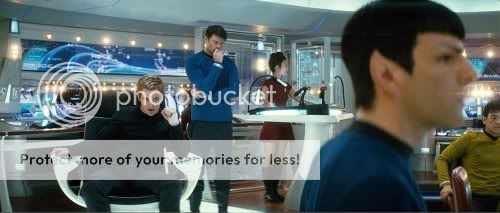 The main Good Thing is the casting. Every one of the leads does a good job capturing the spirit of the character (and actor) they are portraying, in particular Karl Urban as Leonard McCoy/Deforest Kelly (let's face it, these people are inseparable from their characters on this show). I was thrilled to get hints of McCoy’s backstory (sadly just hints) as we discover the origin of the nickname “Bones” (which is not the obvious one you’d think -- a contraction of “sawbones” that has traditionally been used for military doctors for centuries -- and thus felt a bit contrived to me), and I thought Urban stole every scene he was in.
Almost as good was Zachary Quinto, an inspired choice for Spock who passes both the look test and (in my opinion) studied hard the *early* Spock we saw in the pilots and first episodes of the TV show (as this *is* meant to be early representations of these characters, right?) and nailed it pretty well.
Zoe Saldana plays Lt. Uhura, who is given an expanded role in this movie, and I think I would have encouraged her to be just a bit more soulful, but her part is more surprising than important to the story so her actual performance is secondary (blatant spoiler: she is Spock’s love interest -- surprise! -- in what is sure to be the most controversial aspect of the film). In terms of what she actually does viz the plot, it’s pretty much the same thing as the original Uhura -- make a dashboard full of coloured lights look good.
 A fellow of my acquaintance, comic actor Simon Pegg, shows up late to bring us his Montgomery Scott. His take on the young engineer (which leads back to some directorial comments I’ll save for later) is different to the others, in that he doesn’t really try to ape James Doohan’s portrayal much at all (other than putting on a Scottish accent), but still does capture the mischievous nature of the character and will be accepted going forward.
I’m a bit compromised here as I know the fellow and generally like his work, but I have to confess that a) his Scottish accent is a bit variable and occasionally absent (most non-Scots won’t notice this, however) and b) someone should have slapped a wig on him. Pegg's pretty bald, and Scott ... you know, wasn’t. If you’re going to take the care to give Quinto the regulation Moe Howard/Beatle cut (Vulcans, apparently, never change hairstyle -- ever!), then I do not believe that we make it to the 23rd Century without a cure for male pattern baldness. Put a fucking wig on, Pegg. That goes for the otherwise-very-enjoyable Anton Yelchin as Chekov too.
In some ways, John Cho as Sulu had the toughest job. Sulu was a secondary character to start with, and never got that many lines or plots in the original series, so Cho has to remind us of him while having very little screen time or dialog to work with. I thought he did well with what he had, and hope Sulu gets more of a plotline in the next film (and oh yes, you read it here first, there will be a second film!).
Which leads us back to Kirk. At the risk of stating the obvious, Chris Pine is no Shatner, and that's both good and bad (but mostly good, at least for him). His performance is a star-making turn to the point that he will probably bed as many women-of-suspicious-origin in the next few months as Kirk did in the TV show. Oddly, he does the worst job of the entire cast at channelling his predecessor (beyond having a passing resemblance) -- I can only imagine this was a deliberate choice on Abrams’ part -- and only pays lip service to the Shatnerian qualities of the character (yes, “Shatnerian.” Look it up).
Of course, Pine is far too busy running, jumping, fighting, hitting on women, and particularly dangling off slick platforms and/or being choked (repeatedly!) to bring much subtlety to the performance, and I suppose in that sense he is Shatnerian (heh), but I was disappointed that Pine didn’t at least incorporate a little of that Trademark. Halting. Speech. in his performance. Just a touch, man, is that too much to ask?
The second Good Thing about the film (and the thing that forgives most of its flaws) is the clear and unmistakable love of the original show Abrams, his writers and cast put into this. There are plenty of references that the general public will recognise, a lot of one-liners only the hard-core will smirk at, and a healthy littering of homages to the original TV series. This gives the movie a charm and familiarity even as we are asked to follow Abrams to somewhere a bit “new,” and saves Star Trek from being just another space action movie (albeit one with iconic characters in). Abrams is in my view (based primarily on this film and Cloverfield) not really a very good director, but he has a very clear idea about what he wants to see on-screen and won’t let a little thing like physics or sense get in the way of that.
 His obvious choice to let the actors themselves incorporate as much or as little of the original characterisation as they see fit and re-use of some of the same ideas as his earlier work speaks of some laziness on his part, as though he was satisfied that the look and feel were sufficiently new and didn’t care if they got everything exactly right. How one could work diligently to make sure the music was just right (and it is) and yet do something flatly impossible (in any century) such as build a starship on the ground for the sake of a nice-looking matte shot is the kind AADD sloppiness that probably works in his favour with the target market (ie, AADD sci fi fans).
The final Good Thing about this film is that it covers a lot of ground and concepts, just as any good sci-fi movie should. After an initial sequence covering Kirk’s (alternate) birth story, we jump around from Iowa to Vulcan, to San Francisco for some Starfleet stuff, then off to deep space, Delta Vega, black holes and back and forth with epilepsy-inducing rapidity. I’m old and used to the slower pace of the TV series and previous movies, but the rapid-fire editing didn’t bother me as much as I feared; most of the time (note: most), the quick gasps of exposition were sufficient for me to follow the tale and of course younger viewers are very much used to the minimal-information-maximal-action style of today’s movies and TV. But I do have to pause here to give out my first Film Flaw:
Brickbat #1 - Steady the Fucking Camera Already!!
Probably because I have sensibly skipped most recent “high action” flicks like The Fast and the Furious etc., the overwhelming use of what I call “shakycam” is highly annoying to me. There are moments when the effect is quite desirable: when a torpedo hits your ship, for example, and the theatre (or your home stereo) is capable of complementing this with powerful Dolby 7.1 surroundsound, you want “shakycam” to add visual punch. I get that, and enjoy it when applied judiciously.
The problem is that Abrams uses that technique nearly continuously, so much so that non-shakycam sequences are actually noticeable, which is bad. In their effort to make the CGI effects and such look more realistic, Abrams decided on the same unrelenting “documentary” feel that made Cloverfield hard (for me) to watch and is what prevents sensible people from ever seeing The Blair Witch Project more than once. Shake, wander, lens flare, jitter, handheld -- the entire universe of Photoshop cam effects are present and accounted for. Does this make those sequences more realistic? Perhaps. But the “amateur/handheld” feel has a different effect on me; it reminds me that this is artificial, that it’s a deliberate move, and thus disturbs my suspension of disbelief greatly.
That said, the film does finds time to touch on many of the fundamental pieces of Roddenberry’s philosophies, from the role of Starfleet to the struggle of progression in civilisation and how we balance logic and emotion in that. New-Age Trekkies will be pleased. Next, let's look at something that I get the distinct feeling is less important with younger fans than it is with me:
Brickbat #2 - The Plot is PATHETIC!
 One is often too busy “drinking it all in” on action-and-sfx-orgies like this one to really think too much about the plot, but even as I was sitting there I had more than the usual number of “wait a minute ...” moments. Now, this is hardly the first time a Trek plot had some problems, but most of them could at least be followed. This one is damn near incoherent, and that’s not just my opinion -- I dare you to try to get anyone just out of the theatre to explain in a meaningful way the whole “revenge of Romulus” plot in a manner that makes sense. Hint: they won’t be able to, in part because the SFX, pacing, non-linear editing and general cacophony distract one from the details, but also because the details don’t make a lick of sense. It is *required* reading to pick up the comic-book prequel, Star Trek: Countdown (!!) in order to follow the actual storyline, and even then there is a fertiliser truck’s worth of incredulity to spread around. You can download issues of this digital comic onto your iPhone, which would be helpful before going to see the film. Pity they don't tell you this.
Here’s what else the movie doesn’t tell you: ironically, the character that “died” first in the original movies (Spock, in Wrath of Khan, though he is reborn in the next film) lives far longer than any of the other crewmembers (a feature of both his Vulcan heritage and rebirth, apparently). Very late in the 24th century, Spock is still alive and still active as a diplomat in the Federation (this is the time period “Next Generation” was set in, and the comic features plotlines involving those characters).
All of the above is not referenced in any way in the film.

Really, Starfleet couldn’t find anyone other than a 200-year-old Vulcan to handle this job??
The captain of the Narada, a Romulan miner named Nero, is enraged by the destruction of his home planet. He and his crew shave their heads and tattoo themselves in mourning, and vow revenge on Spock, but somehow (MAGIC!!) Nero came out of the wormhole 25 years before Spock’s ship will, though he doesn’t know this quite yet. In a fury, the Narada attacks the science vessel USS Kelvin, on which are Kirk’s father George (as first officer) and his very pregnant mother Winona Kirk (played by Jennifer Morrison). The attack completely alters the timeline from that point forward, creating the “familiar but quite different in places” alternate timeline in which the entire movie takes place (so that's why Chekov has curly hair!). George Kirk sacrifices himself and the ship to buy the crew of the Kelvin (including Winona) time to escape, and Nero discovers that Spock’s ship will emerge from the wormhole in 25 years, so they wait for it (!!).
Now, before we go any further, ask yourself this question: Imagine you are Nero, and you have just been flung into the past in your very advanced technological spaceship because of the traumatic destruction of your home planet and its people. Do you:
a. Head to Romulus, show off your ship as proof of your claim you are from the future, and help the Romulans to escape their terrible destruction, or do you
b. Sit around for 25 years and wait for the guy who didn’t save your planet to show up so you can extract revenge?
Yeah. It took me a while to notice this gaping huge plothole, but there it is. But sit tight, it gets stupider later on ...

We take a break from that to watch Kirk and Spock grow up in their wildly-different worlds. Kirk is a snotty tearaway seen driving a Corvette (in the 23rd century!) using stick (!!!) and seemingly deliberately trying to kill himself, while Spock is the picked-on über-nerd his fan base will strongly identify with (constantly catching logical flak because his mother -- played by Winona Ryder, well hello there stranger! -- is human). Jump forward ten years or so (because apparently nothing else of interest happened between 11 and 21 years for these two), where Kirk is being a snothead at the local bar (trying to hit on Uhura, whom he doesn’t yet know) and Spock is turning down a spot in the Vulcan Science Academy. Both are persuaded to head for Starfleet training (this is where Kirk meets McCoy), and then we jump again another three years and now Kirk and McCoy (and everyone else who are completely unaged from three years earlier -- tell me, did you look exactly the same at 21 as you did at 25?) are pals (a bonding we don’t get to see), Uhura is still unattainable and the Kobeyashi Maru test referenced in Star Trek II is brought to life. This is one of the most purely entertaining bits of the film, at least for a diehard Wrath of Khan guy like me.
Suddenly there's a problem on Vulcan, so we all have to get on the Enterprise and go zooming off, because apparently Starfleet doesn't have anyone else but a ship full of green cadets and Captain Pike (very different from the TV version, older for a start and more of a father figure to Kirk -- in the TV series they'd never met until Spock's court martial -- damn that alternate timeline!).
Herein we get to the nub of what’s wrong with this movie, and it’s surprisingly not the huge chunks of missing backstory, the implausible physics or the hackneyed time-travel thing: the problem with this film is that it's just a series of (very, very well-done and enjoyable) set-pieces that don’t hang together at all. The car sequence is well-done (though silly), the bar fight is well-done, the brief pre-ship Starfleet sequence is well-done (and funny), and many of the ongoing set-pieces (the parachuting to the mining platform, the Delta Vega sequence, the climax and so on) all click beautifully as individual scenes, but often don't connect together or serve the story very much, even after the plot settles down and becomes linear in the storytelling.
 The film's addiction to action sequences also gets in the way of deeper understanding. In particular, the scene on Delta Vega (Kirk has been marooned there by Spock -- they don't get on well at first, which is a brilliant idea) could have been a perfect opportunity to slow the film down for a bit, chew over all that’s been revealed so far and -- particularly once Old Spock shows up -- act as a intermission/prelude to the non-stop eye-candy orgy that’s coming. But no, they have to make it an action sequence. A particularly ridiculous one too, I might add (think Star Wars ep V meets Jurassic Park). If this was the moment where they were paying homage to the original’s sometimes campy moments and dodgy special effects, then they got it spot on. Otherwise, it’s pretty embarrassing.
So by an amazing coincidence (MAGIC!!), young Kirk happens to stumble across Old Spock, who (we discover in the one-and-only moment of true stop-everything-here's-some-plot-exposition goodness) finally came out of the wormhole 25 years after the Narada, was duly captured by Nero, and deposited on this planet so he could watch helplessly as Nero -- in revenge, remember -- destroys the planet of Vulcan and its six billion inhabitants (and this does in fact happen -- a lesser film would have made this the whole focus of the movie). Somehow (MAGIC!), Spock inherently understands that all this has altered the timeline, that “his” past has now never happened and that this young Kirk in front of him is a somewhat different version of his (now long-dead) friend. You'd think that would get a reaction, but this is Spock we’re talking about (Spock is, however, the only one who calls him “Jim”). Leonard Nimoy returns with the same casual elegance as he always had (and some nice “aging” makeup!), but I wish he had enough of his youthful vigour to squeeze out more -- ahem -- “logical” explanations of what’s going on.
Having just been responsible (indirectly?) for screwing up the universe’s entire timeline, Old Spock quickly sets about deliberately messing with the future (!!!) by letting Kirk in on what’s going to happen and by manipulating him to influence events in a particular direction. This strikes me as very UN-Spock, but hey he’s 200+ years old now, who’s to say. Let it go.
Old Spock and Kirk journey to the conveniently-nearby Starbase Outpost, where they meet Scotty. Spock again manipulates the future by revealing to Scotty the secret of “teleporting to or from a moving target,” the very thing young Engineer Scott was famous for inventing (in the “original” timeline) -- normally I’d assign another (!!!!) to this, but I’m almost out of exclamation points and besides, they did something like this before in Star Trek IV, so that makes it ... um, okay? Let it go.
Kirk and Scotty (but not Old Spock) beam back onto the Enterprise into one of the handful of purely-comical scenes which is very amusing but also shows up a serious design flaw (more about that later) and we’re back in the thick of the ongoing attempt to stop Nero, who (having succeeded completely with his evil plan for revenge -- I think that’s a sci-fi first isn’t it?) has decided to now destroy all the Federation planets (bwa ha ha!), and is still in need of stopping.
Kirk, on the direct advice of Old Spock, tricks Spock into giving up the captaincy of the Enterprise (Pike is being held hostage, forgot to mention that sorry) and assumes command. Spock, having moments ago been ready to (literally) kill Kirk, does a 180 and offers to help, and with newcomer (and whimsically funny) Scotty given -- completely insensibly -- carte blanche over the engines (was there no chief engineer before?), we’re off to something of a predictable confrontation and (rather hollow, really) victory over Nero.
This review is already longer than the screenplay of the movie its reviewing, but I have one more brickbat to give out:
Brickbat #3 -- Design consistency? What’s that?

The “new” set for the bridge of the young Enterprise is of course nothing like any of the sets that have come before it, a glitteringly clean white-and-blue affair (and a nightmare to keep clean!). Very nice, but if I'm supposed to believe that this bridge came at least a decade or two before the bridge seen in TOS, then Houston, we have a problem.
Adding to that is of course (and again) the inability of the visual team to make the exterior of the original Enterprise or other ships look more primitive than they did in the 60s or even in the movies of the 80s. I guess most people don’t care and maybe I shouldn’t either, but I grew up watching historical recreations on the BBC and “period detail” was of paramount importance then, and that feeling transferred to me and applies even to relative periods of the future. In other words, a story set in X-50 years should look more primitive and cheap than a story set in X, even if X was made first and X-50 was made later.
It's too much to ask from Hollywood, apparently ...
Worse still -- and really unforgivable as this is within the same very high-budget film -- once you leave the bridge and living quarters of the Enterprise, the rest of the ship's interior looks for all the world like a sewage plant. The “clean white everything” look apparently costs big bucks, because Engineering is as full of bare pipes, stark lighting and minimal tech as the back room of your local Costco. It’s one thing for Engineering to have a different aesthetic than the Bridge (though they’ve usually shared a common sensibility), but this engine room looks like it’s from an entirely different movie! And don’t even get me started about the “Yoyodyne” design of the Romulan ship’s interior, right down to the random puddles of murky water!
Oh, and while we’re ranting, will someone please explain why almost every threat to earth in all the Star Trek movies have to take place within view of Starfleet Academy in San Francisco? When Nero decides to blow up the Earth -- which for some reason (MAGIC!) requires drilling a hole to the core to put the Red Matter in, you couldn't just explode the Red Matter on or above the surface -- he just happens to choose the exact same spot where the whales were released in Star Trek IV? Right next door to Starfleet?? Really???
Most incredibly of all, the film seems to end triumphantly -- the crew is complete, everyone’s pals, Earth is saved, Nero is destroyed, etc. -- but in fact if you think about it, the film ends horribly. No attempt is (or will be) made to restore the timeline back to where it “should” be (and remember, Old Spock has plenty of knowledge and experience on how to do this!), the planet Vulcan remains destroyed (but Romulus will now be spared -- I think -- because now everyone knows the future fate of that planet), which means the crew failed their first mission!
Spock’s race (six billion people!) and planet is all but wiped out (Old Spock leaves to start a colony with the few remaining survivors), and the past we (the audience) all know and love is gone. Nero’s revenge is complete and untouched, and though the future is now more “wide open” than it was because the “original” continuity has been wiped, we won’t see these “new” versions of the characters grow into the ones we remember.
I might add on a personal note that even all this time after 9/11, watching someone deliberately set off a (kind of bomb) that kills indiscriminately and leaves only a smoldering ruin behind was a little hard to watch. The imploding Vulcan was just a little too much like the collapsing towers for my taste. Effects are getting too real, I guess ...
None of this, even with all the extensive nitpicking I’ve done, takes away from the overall effect of the movie: good, funny (and the funny is much appreciated), well-executed space opera that gives us plenty of big-screen, expensive-looking thrills and laughs that will entertain and amaze you, especially if you don’t think about it too hard. So, “boldly” go see it, and let me know what you think; I’d be very interested to hear.
ADDENDUM: Just thought of this yesterday -- at the end of the movie, we are left with two Spocks, both of whom are known to the Federation (and thus living proof that time travel works) and one of whom has extensive knowledge on how to manipulate time and history. But the Federation are just going to let Old Spock go off and start a Vulcan colony? Oh I don’t think so ...
The COWs of Spring
Apr 28, 2009

We also are pleased to announce that we now have a fan page on Facebook which we hope you’ll join.
With a little luck we may have a “special episode” available for you in May ... stay tuned for more on that ...
A Small Digression
Apr 22, 2009
We don’t normally cover short films on this blog, and are even less inclined to cover or promote web-only films, but for this one -- Responsible Relationships and You: Facebook Manners -- we’ll gladly make an exception.
First of all, as a parody this short is note-perfect. Not since the days of Night Flight on the USA Network in those bygone early days of cable has their been such a beautifully realised parody of the generic 50s-era “educational” film. Second, enough readers are on Facebook or at least know about it for the concept to carry beyond the confines of the web. Finally, it’s cleverly retro-futurist “steampunk” design recalls both Brazil and the 1939 World’s Fair with equal aplomb, and rich reward for those willing to freeze-frame and read the text flashed on-screen. I predict “Timmy Gordon is uh oh” to join other Net-centric catch-phrases like “I KISS YOU!!” and “All Your Base” in short order. Remember, you read it here first!
The best way to experience this mini-masterpiece is to visit YouTube and enjoy it in its full HD glory, but I give you a bite-sized version here in HD to whet your appetite:
Stone of Destiny (2009)
Apr 7, 2009
96 Min.
Writer/Director: Charles Martin Smith
Stars: Charlie Cox, Billy Boyd, Robert Carlyle
 Here’s a story you don’t see all that often: a true account of a daring raid for national pride and glory that’s set after WWII. Charles Martin Smith (best known for his role in “American Graffiti” but like his co-star Ron Howard more of a writer/director these days) has fashioned a stylish-looking, involving tale of Scotland’s most famous heist (or as they might say “liberation”), the repatriation of the “Stone of Destiny,” a rock with historical ties going back at least seven centuries (and, legend has it, back to Old Testament biblical times -- this is the stone which Jacob is thought to have used as a headrest).
“People of Scottish ancestry” is probably not an identifiable target market in demographic terms, but in fact such people are all over the world, and most will walk with a little more swagger in their step after viewing this, particularly if it’s marketed properly. On Christmas Day in 1950, a motley (and yes, rag-tag) group of nationalistic college students led by one Ian Hamilton executed the greatest “student prank” of all time: breaking into Westminster Abbey in London and making off with the “Stone of Scone,” a huge (and heavy) sandstone rock that had been used to crown Scottish monarchs since around 847AD, and was stolen from Scotland by Edward I in 1296. He built a special coronation chair that incorporated the Stone in its base so that all future monarchs would also (by tradition) be crowned Kings of Scotland as well as England.
The movie is based on Ian Hamilton’s memoirs and seems to stick pretty closely to what really happened (or as close as movies with any sense of dramatic tension get, anyway), which is refreshing. As with most true tales, there’s a bit of unresolved business (because life isn’t really all that neat and tidy), some cowardice to go with the bravery, some seemingly-ridiculous or implausible moments (but they did happen!), and more “running about for nothing” than you find in neatly-scripted fictions. I was surprised at how funny much of the heist and its planning was, but hindsight helps such things ring true. As the instigator of a few “adventures” in my own life, I could relate to the missteps and foibles of the plan and its executors, and the youthful fervor of Ian Hamilton (played by Charlie Cox, who is English but does a good job with the Scots accent).
 Genuine Scottish nationalists might bristle at the “gloss” Smith has given the film (loving landscape shots, shorthanded Scottish character types), feeling it a bit superficial -- particularly in its lack of any criticism of the English -- but particularly for adult moviegoers, “Stone of Destiny” has the right mix of action and detail, nostalgia and laughs. The reaction to the gang’s bold move back in Scotland is particularly well-handled and will likely bring a lump to many a patron’s throat.
Looking back on one’s youth is often a risky business, but though the stunt may have ended up coming for naught (the Stone was quickly recovered and sent back to Westminster, though it is currently “on loan” to Scotland until the next UK coronation), Smith’s affectionate look back at a great slice of modern Scottish history should give audiences young and old a wee grin on their faces.
This review originally appeared on Film Threat.
March Episode Now Available!
Mar 30, 2009
 Just in the nick of time, the March episode of Chas’ Crusty Old Wave is available for download either via the website or directly from iTunes. This episode features a focus on Elvis Costello’s “Brutal Youth” album, some rants against the then-new teen curfew in downtown Orlando, and best of all, Liz Langley's hi-larious Horror-scopes.
Not to mention a ton of good old-fashioned alterna-rock back when the term meant something.
Those of you who check it out via iTunes, could you take a moment and rate/comment on the podcast? It will help get the word out. Thanks!
Back on iTunes!
Mar 20, 2009
After a short fubar-esque delay caused by a bug in iWeb 09, I'm pleased to report that Chas' Crusty Old Wave - The Podcast! is now available again on iTunes. Subscribers should finally be getting February's episode (#63).If you are not already a listener, and think you would enjoy a rather smart-alecky tour of the best in obscure New Wave Music as only college radio can provide, you can easily subscribe through iTunes by clicking here, or if you do not have iTunes (what?!) you can always visit the website directly here.
Enjoy!
The Islands Project (2008)
Mar 10, 2009
Running Time: 102 Min.
Canada 2008
Director/Writer/Star: Michael Stadtländer
 One of the world’s top chefs decides to take a unique summer vacation -- driving from Ontario to the obscure islands of British Columbia in a biodiesel bus-cum-mobile-kitchen, preparing exquisite outdoor dinners using local ingredients, local themes and local farmers. He calls it “The Islands Project.”
From the start, we can see that chef Michael Stadtländer is a happy -- but quirky -- guy. He lives on Eigensinn Farm where he grows almost all of the ingredients (from livestock to plants) that will go into his occasional, but $300-or-so-per-person, eight-course plein-air dinners for select gourmands. The farm has earned a rep as one of the top dining spots in the entire world thanks to this approach, but Stadtländer (who also wrote and directed this documentary) seems happiest when he is able to share this experience beyond the farm. Once “The Liberator” (his hippie kitchen-on-wheels) arrives in Canada’s west coast, he wastes no time finding and visiting farms and farmer’s markets scattered across Vancouver, Quadra and Cortes Islands, meeting artists and farmers, picking berries, discovering new foods and local delicacies, and consulting with locals (and the occasional celebrity-chef pal) to get ideas for his haute cuisine dinners, which are usually outdoors and always use unusual themes (a “table” made of stacked deadwood, plates made out of wooden starfish, or a dinner on a floating platform in the middle of a lake) that present challenges to him and his assistants.
The meals are, of course, extraordinary, creative and delicious-sounding, and are run not unlike a field military exercise. Stadtländer commands totally, directing not just the cooking but the furniture (helping make it if need be!), lighting, atmosphere and decor as required. The only rules for the variety of fare at these meals is that it must be ecological, sustainable and edible. If the film has a flaw, it’s that there isn’t enough footage of the dinner conversations themselves, or reactions to specific dishes. Also omitted is almost any mention of any “failed experiments” or unexpected surprises. The chef prefers to teach us all (including the locals) what might be called “food respect”; how to cook these incredibly fresh, home-grown items and how best to enjoy them within their natural setting, the outdoors.
 Oddly enough, the highlight of the film are actually cutaway interviews Stadtländer does with farmers, fellow chefs and the occasional oddball. At the beginning of the film, we see him buying a disused console TV (one of those big honking 70s jobs), whereupon he hollows it out leaving just the front face, creating his own “TV show” on the road. These funny bits keep the mood light and break up the “go to an island, gather foods, prepare them, wow the natives” cycle of the dinners.
The final dinner takes place on an uninhabited island, so the entire “set” for the dinner must be constructed from found elements, a perfect complement to the dinner of found ingredients and visiting guests. This “vacation” looks like a hell of a lot of work to us, but Stadtländer seems content when it’s all done and time to go back to his farm. If you’re a “foodie,” you will enjoy this (even vegetarians, though there are scenes of meat being made if you catch my drift); if you’re an environmentalist you will love this; if you are both, this movie is one prolonged orgasm of sheer sensual pleasure.
This review originally appeared on Film Threat.
This review originally appeared on Film Threat.
Crusty Post!
Feb 27, 2009
Those of you who are subscribed to my podcast -- Chas’ Crusty Old Wave -- via iTunes will have to wait a bit for the February episode to show up.Apple made some changes in how iWeb interacts with the iTunes store, so while all the old episodes are still available, the new one (#63 from 30-Oct-92) is not yet there. They are aware of the problem, and presumably will take a break from working on iOwnEverything to fix it in due course.
Those who do not subscribe via iTunes, the new episode is up on the web site. Enjoy.
Subscribe to:
Posts (Atom)